



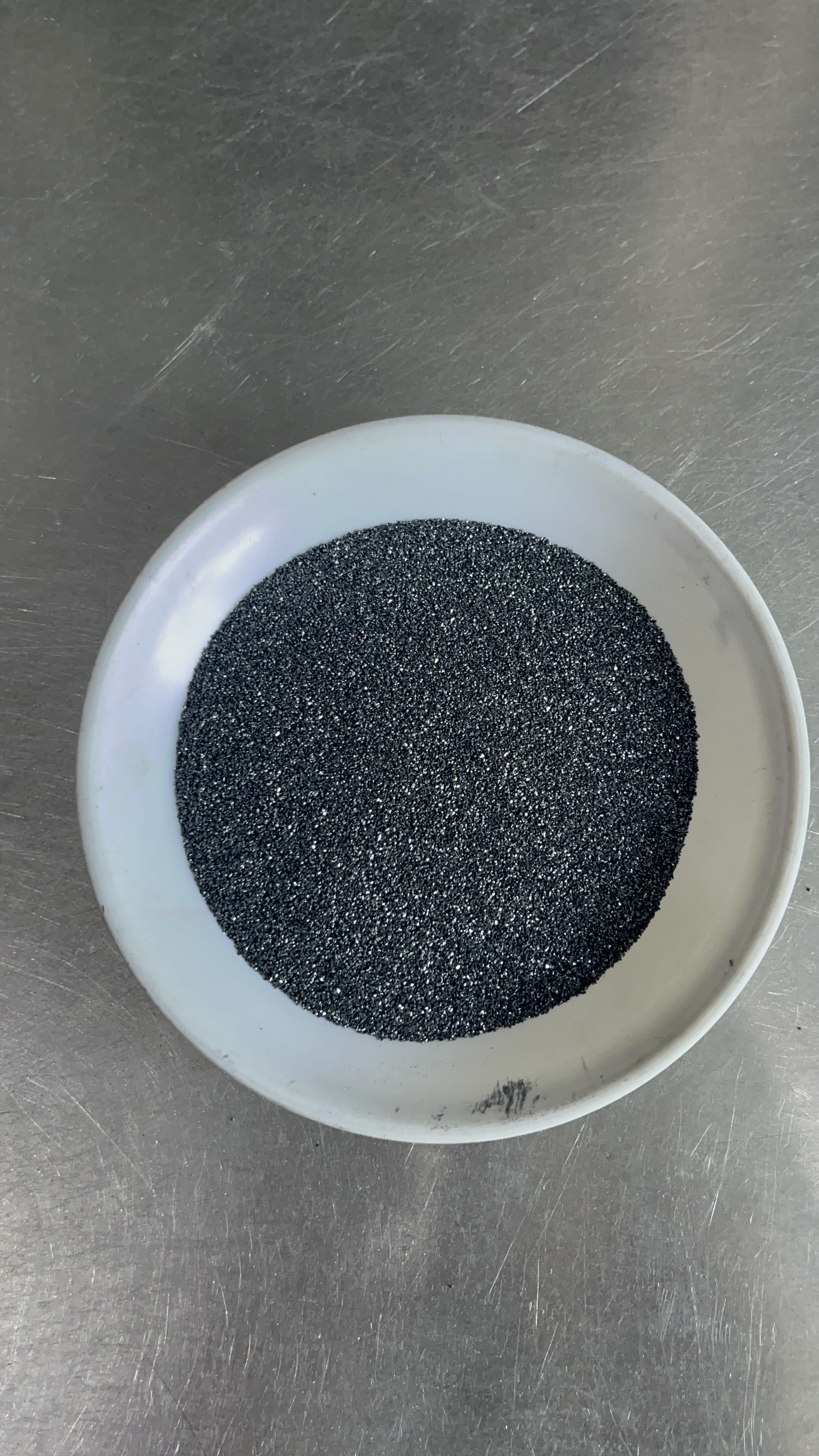



1. black silicon carbide (SiC), also known as carborundum, is a compound of silicon and carbon with chemical formula SiC.
2. black silicon carbide (SiC) is made from quartz sand and petroleum coke( or coal tar), wood chips as raw material through high temperature smelting in electric resistance furnace.
3. black silicon carbide (SiC) can be used widely for abrasive sand, refractory material, and deoxidizer for foundry and steel casting etc.
Inquiry
|
Silicon Carbide Micropowder (Special Filler for Particle Glue) — Product Introduction
Product Overview
Silicon carbide micropowder is an ultrafine powder material primarily composed of silicon carbide (SiC), specifically designed for particle glue (wear-resistant ceramic particle glue) formulations. As a functional wear-resistant filler, it is blended into epoxy resin, rubber, and other matrix materials to significantly enhance the wear resistance, compressive strength, and thermal conductivity of the cured product. It is widely used in wear-resistant coatings, equipment repair, and pre-protection applications.
Product Features
1. Ultra-High Hardness, Significantly Improved Wear Resistance
Silicon carbide has a Mohs hardness of 9.5, second only to diamond, making it an ideal wear-resistant additive. When added to particle glue, the SiC micropowder forms a hard wear-resistant framework within the adhesive layer, effectively resisting material erosion and wear. Studies show that wear-resistant adhesives using SiC micropowder as a filler can achieve wear resistance 23 to 44 times that of stainless steel.
2. Good Wettability, Uniform Dispersion
Silicon carbide micropowder has excellent wettability for various resins and good adsorption properties. It does not easily agglomerate during mixing and can be uniformly dispersed in the adhesive. With a large specific surface area and good bonding with epoxy resin, it effectively improves the compressive strength and bond strength of the adhesive layer.
3. Excellent Thermal Conductivity
Silicon carbide has an extremely high thermal conductivity, second only to diamond. When blended into particle glue, it improves the heat dissipation performance of the adhesive layer, making it suitable for applications requiring thermal conductivity or temperature resistance.
4. Strong Chemical Stability
Silicon carbide is resistant to acids, alkalis, and corrosion, with high chemical inertness. It maintains stable performance under various harsh working conditions and does not react adversely with other components.
Technical Specifications
| Item | Parameter |
|---|---|
| Chemical Composition | SiC |
| Mohs Hardness | 9.5 |
| Common Particle Sizes | W0.5, W1, W1.5, W2.5, etc. |
| Purity | ≥95% (customizable upon request) |
| Appearance | Gray or grayish-white powder |
| Refractoriness | >1600°C |
Application Areas
1. Wear-Resistant Particle Glue
Silicon carbide micropowder is the core filler component of wear-resistant particle glue. In epoxy resin-based wear-resistant adhesives, the typical addition amount of SiC micropowder is 18–38 parts by mass, providing skeletal support and wear resistance. When used in combination with lubricants such as graphite micropowder, wear performance can be further optimized.
2. Equipment Repair and Pre-Protection
Used for wear repair and pre-protection coatings on pump bodies, impellers, pipe elbows, hydrocyclones, fan housings, and other equipment. Recommended coating thickness during application is 4–15 mm, adjustable according to the degree of wear.
3. Rubber Composite Materials
Adding silicon carbide micropowder to a rubber matrix can improve tensile strength, wear resistance, and thermal conductivity. Studies show that adding approximately 2% nano silicon carbide can increase rubber wear resistance by 20%–40%.
Usage Recommendations
-
Addition Ratio: For epoxy resin wear-resistant adhesives, the recommended addition is 18–38 parts per 100 parts of resin by mass
-
Particle Size Selection: Choose appropriate particle size based on coating thickness and working conditions; W1–W2.5 is commonly used
-
Mixing Method: Use mechanical stirring or ball milling to ensure uniform dispersion of the micropowder in the adhesive
-
Surface Treatment: For more demanding applications, silane coupling agents can be used to modify the micropowder surface, improving interfacial bonding with the resin
Packaging and Storage
-
Packaging: 25 kg/bag (woven bag or paper-plastic composite bag), or customized per customer requirements
-
Storage: Store sealed in a dry, cool environment; avoid moisture and agglomeration
-
Transportation: Ship as general cargo; avoid heavy pressure and contact with oxidizers


